Last checked Due a review
Key facts
- Duration
- 20 to 25 days on the trail from Taplejung
- Highest point
- 5,143 m (16,873 ft) at Pangpema (North Base Camp)
- Total distance
- 225 km
- Difficulty
- Strenuous, 4 of 5
- Best months
- March to May and October to November
- Months to avoid
- January, June to August and December
- Starts and ends
- Taplejung (1,820 m) — via flight from Kathmandu to Biratnagar then to Taplejung, or overland to Taplejung or Ilam
- Accommodation
- Teahouse lodges
- Permits
- Kanchenjunga Restricted Area Permit, Kanchenjunga Conservation Area Permit (KCAP)
- Typical cost
- $2,500 to $4,500 per person, guided
- Experience needed
- At least one multi-week Himalayan trek is strongly recommended. The route has limited rescue options and requires self-sufficiency.
Why trek to Kanchenjunga if it is so remote?
Because no other Nepal trek combines this level of wilderness, cultural authenticity, and closeness to an 8,000-metre peak with so few other trekkers.
Kanchenjunga receives fewer than 1,500 trekking visitors per year compared to over 50,000 for the Everest Base Camp region. The result is an experience that recalls what Nepal trekking was like before mass tourism — empty trails, teahouses where you are the only guests, and communities that haven't adjusted their rhythms to outsider expectations.
The north-south traverse is the definitive Kanchenjunga experience, giving you face-to-face encounters with both the north wall (Pangpema, 5,143 m) and the south face (Yalung, 4,800 m) of the same mountain from completely different perspectives.
Kanchenjunga Base Camp Trek itinerary, day by day
The full 22 day schedule, with sleeping altitude, walking hours and overnight stop for every day. The acclimatisation days are the ones that decide whether people finish.
Day 1
Kathmandu to Taplejung
- 1,820 m
- Rest day
- 600 km
- Sleep: Taplejung
Fly or take the long overland route to the trailhead in far-eastern Nepal.
Read the dayShow less
The easiest approach is to fly from Kathmandu to Biratnagar and then take a smaller aircraft or shared jeep to Taplejung. Direct flights to Taplejung are available on clear days.
Transport: Flight Kathmandu to Biratnagar (1 hour), then to Taplejung (30 min) or overnight bus
Day 2
Taplejung to Mitlung
- 900 m
- Down 920 m
- 12 km
- 4 to 5 h
- Sleep: Mitlung
Begin descending into the Tamor River valley — the Kanchenjunga approach corridor.
Read the dayShow less
The trail descends from Taplejung through terraced fields and subtropical forest to the Tamor River. Mitlung is a small Tamang village in the warm lower valley.
Day 5
Amjilosa to Ghunsa
- 3,595 m
- Up 700 m
- 14 km
- 5 to 6 h
- Sleep: Ghunsa
Arrive at the main base for acclimatisation before the north base camp approach.
Read the dayShow less
Ghunsa is the highest permanent settlement on the north side of Kanchenjunga. The Tibetan-influenced village has a monastery and is surrounded by conifer forest. Spend 1 to 2 extra nights here for acclimatisation.
Highlight: Ghunsa village — gateway to the north Kanchenjunga wilderness
Day 9
Pangpema (North Base Camp)
- 5,143 m
- Up 820 m
- 10 km
- 5 to 6 h
- Sleep: Lhonak (return)
The northern highlight of the trek — Pangpema viewpoint facing the north wall of Kanchenjunga.
Read the dayShow less
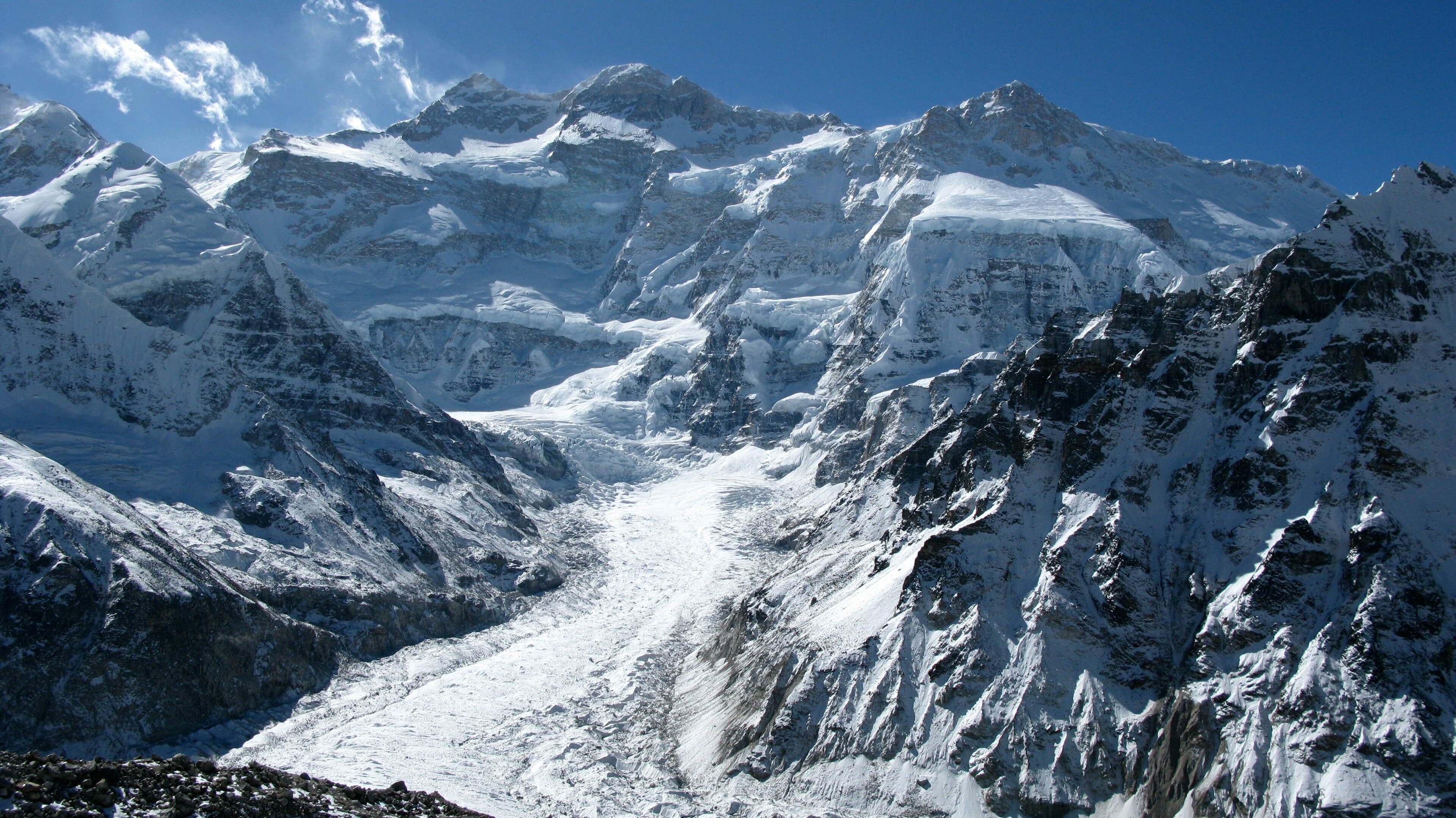
The glacier approach to Pangpema is one of the most dramatic landscapes in all of Nepal. The sheer north wall of Kanchenjunga rising from the Kanchenjunga Glacier is breathtaking. Return to Lhonak the same day.
Highlight: Pangpema at 5,143 m — face to face with Kanchenjunga's north wall
Day 16
Yalung (South Base Camp)
- 4,800 m
- Up 700 m
- 10 km
- 4 to 5 h
- Sleep: Ramche (return)
The southern highlight — Yalung Glacier and the south face of Kanchenjunga.
Read the dayShow less
The south approach through the Simbuwa Khola valley gives a completely different perspective on the mountain. The Yalung Glacier's moraine leads to the base camp viewpoint facing the southwest face and the Twins peak.
Highlight: Yalung Base Camp — the south face of Kanchenjunga at 8,586 m
Day 22
Return to Taplejung
- 1,820 m
- Rest day
- 30 km
- Sleep: Taplejung
Complete the south-to-north traverse and return to Taplejung.
Read the dayShow less
From Yamphudin the southern exit route leads back to Taplejung via Khebang and Phurumbu. Arrange flight or overland transport back to Kathmandu from Taplejung.
Transport: Walk or jeep from Yamphudin to Taplejung
What is included and what is not
One of the most demanding teahouse treks in Nepal due to the remoteness, altitude, duration, and the physical demand of the full north-to-south traverse. Not recommended for first-time Himalayan trekkers.
Included in a guided price
Restricted Area Permitabout $$80–120
Kanchenjunga RAP
Conservation Area Permitabout $$20
KCAP
Accommodationabout $$200–300
21 nights teahouse and camping where needed
Mealsabout $$210–315
All meals on trail
Guideabout $$420–600
Experienced Kanchenjunga-certified guide
Porterabout $$320–480
Required due to remoteness and supply weight
Not included, budget for it
Internal flights
Kathmandu to Biratnagar to Taplejung
International flights
To and from Kathmandu
Comprehensive travel insurance
Mandatory — helicopter evacuation from remote areas is very expensive
Permits for the Kanchenjunga Base Camp Trek
Kanchenjunga Restricted Area Permit
Issued by Department of Immigration, Nepal
USD 20 per person per week for the first 4 weeks, then USD 25 per person per week thereafter. Must be arranged through a registered agency. Mandatory licensed guide.
Kanchenjunga Conservation Area Permit (KCAP)
Issued by Department of National Parks and Wildlife Conservation
- Foreign
- NPR 3,000
- SAARC
- NPR 1,500
Separate from the restricted area permit. Buy at the DNPWC office in Kathmandu or at the trailhead.
What to pack
Excellent physical fitness and prior high-altitude trekking experience required. You should have completed at least one previous Himalayan trek above 4,500 m before attempting Kanchenjunga.
Clothing
- Heavyweight down jacket -20°C rated
- Waterproof hard shell
- Multiple thermal base layers
- Warm hat and balaclava
- Heavy gloves with liner gloves
- Gaiters
Footwear
- Stiff mountaineering-compatible boots
- Gaiters
- Camp boots or mukluks for cold nights
- 5 pairs heavy wool socks
Equipment
- Trekking poles
- Sleeping bag -20°C rated
- Micro-spikes or light crampons
- Headtorch with lithium batteries
- Personal water filter
- Satellite messenger (highly recommended)
Frequently asked questions
Sources checked
- Department of Immigration NepalGovernment of Nepal, checked 10 January 2025
Fees and regulations in Nepal change. This page was last verified on 20 January 2025.